




Authors: Comfort O. Dickson and Kesha Stovall
Introduction
What is instructional leadership? How is it defined, conceptualized and implemented in schools? These are the key questions that encompass and guide this literature review and reflection paper on instructional leadership. Furthermore, this review explores and contextualizes how instructional leadership in relation to school effectiveness research is defined and applied. This is accomplished through examining a multitude of conceptualizations, applications and contextualizations. In addition, a thorough analysis of PIMRS (Principal Instructional Management Rating Scale), an instructional leadership model developed by Hallinger and Murphy in 1985, is utilized to further capture the meaning and applicability of instructional leadership in education. Also, to further comprehend the significance and relativity of instructional leadership, a comparative engagement with transformational leadership is performed. This focuses on the advantages and disadvantages of instructional leadership in comparison to transformational leadership.
Secondly, to support these conceptual and analytical interpretations of instructional leadership, an interlocution with empirical research from four different countries occurs. This illustrates how the IL model in schools are apprehended and implemented based on geopolitical factors and sociocultural dynamics. The countries investigated are: Malaysia, India, Nigeria, and Egypt. To further stimulate this contextual evidence, a detailed probing of research on the obstacles and challenges pertaining to the instructional leadership roles of school principals is performed. The evidentiary section concludes with a discussion on the roles of IL within school organizations and answering the inquiry: who should or can achieve IL roles in school organizations? Therefore, the first part is how instructional leadership vis-a-vis education, school effectiveness and performance is theorized. The second section is how these theoretical and conceptual understandings of instructional leadership are practiced and executed.
The third section is completely reflective and responsive in that it expresses our own cogitations in regard to instructional leadership. This includes contemplations of how our leadership practices can possibly transform in the future given the new information and interlocution with IL research both contextually in practice and conceptually. This section also is inclusive and considers education in Egypt contextually and meaningfully.
Conceptualization
Educational leadership models establish the standards that middle-level and senior-level leaders in a school to assimilate to, utilize and follow. These standards can be formulated and based on several factors. Therefore, what are the defining characteristics of instructional leadership specifically? What are the most prominent concepts delineated in instructional leadership theory? How can these conceptual frameworks of instructional leadership be compared and differentiated from other educational leadership models such as transformative leadership?
Instructional leadership came from the effective school movement in the USA that occurred in the 1980s. This was a movement premised on the idea that the principal’s role is monumental and singular in reproducing an effective and successful school through working closely and collaboratively with teachers and other supervisors. Principals are essentially influencers and agents of behavioral, systemic and climate change. However, this ideological understanding of school effectiveness through the sole performance of the principal came under heavy scrutiny. It can easily be understood as a framework that positions the principal as the individual force that mobilizes and catapults a school into success.
Relying on the efforts, expertise and ethics of one individual has been criticized and characterized as unfeasible and unrealistic. Most understand that working in education is much more complex and collaborative than that. This is why instructional leadership theory has evolved and adapted to these critiques and presented more diverse and distributed forms of educational leadership (which are compared and contrasted shortly). From this movement and ideology came the most prominent model of instructional leadership: Hallinger and Murphy’s PIMRS model (1985). The instructional leadership canon has been perceived as ambiguous and obscure, so there has been great effort in clearly conceptualizing and defining what it actually is and the expectations of such a role. Here I interlock with Hallinger, Murphy, Wang, Rigby and Soctt, as well as more recent understandings on instructional leadership from Liisa Brolund (2016) and Billy Jenkins (2009).
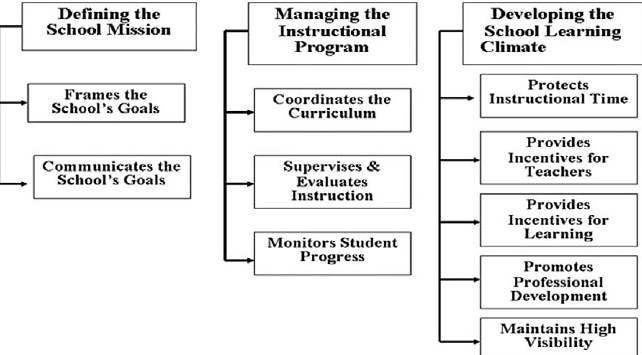
Phillip Hallinger and Joseph Murphy’s conceptualization and modeling of IL from Assessing the Instructional Management Behavior of Principals (1985) has been the most circulated, cited and predominant model when performing empirical research on IL. In their conceptual framework, they originally proposed that the roles and responsibilities of instructional leaders are defined and determined by three dimensions. These determinants and dimensions are: Defines the School Mission, Manages the Instructional Program and Develops a Positive School Learning Climate. This modeling of instructional leadership is referred to as PIMRS, or Principal Instructional Management Rating Scale. Each of the three dimensions are structured to have specific goals, directives and targets underlined for each. The first dimension, “Defines School Mission,” is designated to define “the principal’s role in determining the areas in which the school will focus its resources during a given school year” (Hallinger & Wang, 2015, p. 28).
More specifically, in the diagram this is described in two parts: 1.) frames the school’s goals and 2.) communicates the school’s goals. The criteria of these goals heavily contrast later concepts of educational leadership in that these goals must be based and centered on only academics and learning. Nevertheless, these goals and visions are set to be accomplished and maintained through these two means, both means relying on the complete execution and will of the principal. The first method states an instructional leader must be a motivational, inspirational presence that mobilizes teachers in achieving a common, collective goal at times through their own individual expense. These schools’ goals and visions must also be narrow and limited as to prevent confusion or ambiguity. By narrowing goals down to specific targets, faculty members obtain focus and motivation longer which can result in favorable and successful outcomes.
The second function of the principal is to concisely communicate these goals. This requires implicit and congruous efforts by the principal to consistently reiterate these specific goals and visions throughout the given school year to not just teachers, but to students, their parents and the community overall. Moreover, this dimension is perceived as a mere starting point for regenerating an academic-driven and student-centered educational setting. Essentially, schools need to have clearly defined goals that are consistently reiterated and reinvigorated throughout the school year. More importantly, faculty and staff need to be fully supportive of these visions/goals and be completely engaged and harmonious in achieving them. This is done by incorporating the school vision and goals in their daily practices and planning.
The second dimension is the management of the instructional program. This is outlined by three functions: 1.) Coordinates the Curriculum 2.) Supervises and Evaluates Instruction and 3.) Monitors Student Progress. Under this determinant, teacher supervision, evaluation and observation procedures and practices take place. This is also where students’ performance is organized, analyzed and sustained. Also, this dimension prioritizes curriculum development and implementation. Furthermore, one of the more critical aspects of stimulating and monitoring both teacher and student performance is principals need to be qualified and have expert experience in teaching, learning and classroom instruction. This, in practice, means being active and fully immersed in the given curriculum and teaching program of the school.
The second component is “supervises and evaluates instruction.” This is where the principal confirms that the actual school goals and visions set by the previous parameter are kinetic and practiced in the classroom. This section has historically been problematic begging the question whether teacher monitoring, supervising and evaluations reproduce valuable learning outcomes. However, as stated by Hallinger and Wang: “Within the PIMRS framework, this function emphasizes the importance of developing the instructional capacity of teachers more than on the formal evaluation of teachers” (2015, p. 32). Therefore, the purpose of evaluations is to evolve teacher abilities and their instructional practices in a collaborative, interactive manner which then better accommodates and achieves the school goals. This should not be focused on teacher surveillance, setbacks and other forms of negative reinforcement. In practice, these procedures for teacher development and evaluation are highly misconstrued and misused with biased and pessimistic intentions by educational leaders.
In my opinion, this is why teacher evaluations are rendered as controversial even if in theory, they were never meant to be interpreted or executed in that manner. The second attribute under this dimension is “coordinates the curriculum.” This is an area that is substantial in creating highly effective and successful schools. This job not only involves establishing that the objectives of the curriculum are parallel to the material in lesson plans, but making certain there is cohesion in the curriculum spanning all grade levels throughout the school. This means there has to be consistent collaboration and communication between supervisors and teachers throughout the school; they should not just be limited to internal interactions within one grade level. These relationships and networks within a school are monumental for the instructional leadership model to effectively be implemented. Lastly, the final characteristic of this function is: “monitors student progress.” This is another aspect that can be interpreted and practiced rigidly and controversially because this function relies greatly on standardized tests and assessments. With what we know now about education and learning, standardized tests and assessments are designed to pinpoint a specific criterion that do not account for or highlight the full spectrum of intelligences. These are only useful for principals to get a quantitative understanding of all areas of strengths and weaknesses as it pertains to the standard and criteria.
The third demarcation of Hallinger and Murphy’s original PIMRS model is “develops a positive school learning climate.” This sectioning is not solely defined by student learning and growth, but is inclusive and considerate to teacher learning, classroom management and professional development as well. Thus, the sub-sections under this function are: “protects instructional time, develops professional development, maintains high visibility, provides incentives for teachers, and provides incentives for learning” (Hallinger & Wang, 2015, p. 33). This is the largest demarcation and function out of the three and also intertwines with other forms of educational leadership such as transformational leadership. This dimension is designed to provide the rewards and incentives for both teacher and students if they achieve schools’ goals, mission and implement the curriculum effectively. Therefore, it reproduces a merit system in alignment with the mission and curriculum that allows the instructional leadership mechanisms and cycles to continuously regenerate through the exploitation of rewards and incentives.
Another important aspect of this dimension is, once again, the singular role of the principal in that the principal has to model the delineated values, ethics, morals and practices that they wish to see reflected amongst faculty and the student body. The responsibility of administrators and leaders to model these values is apparent in the function of “protecting instructional time.” This means leaders need to be conscientious of their teachers’ time and not interrupt instruction with non-commonsensical and frivolous announcements, administrative tasks and other disruptive encounters. Instructional leadership here defines the principal as active, highly visible and interactive not just with the teachers, but with the students. Their presence, attentiveness, consideration and interaction with both teachers and students produces positive outcomes. In other words, it makes everyone feel valued, understood and welcomed. Principals in this model are also tasked with providing incentives and rewards for achievement as a means to reinvigorate the PIMRS cycle and stimulate an effective school environment. Lastly, a principal must support and promote professional development. Research has shown that effective learning and teaching happens when principals suggest, encourage and even arrange for professional development seminars, workshops and classes.
The PIMRS model is also foundational for the development of other frameworks of educational leadership and has been reconstituted in several ways. For instance, Murphy several years later (1988) proposed a four-dimensional structure to instructional leadership and framed it as 1.) Developing mission and goals, 2) Managing the education production function, 3) Promoting an academic learning climate, and 4) Developing a supportive work environment. Essentially, Murphy broke down the extremely broad third dimension from the PIMRS model into two concise and manageable parts.
Other scholars, such as Jessica Rigby and W.R. Scott were concerned with questioning the logic behind the development and theorization of instructional leadership. What is the logic behind instructional leadership? In practice, principals’ leadership orientation has not developed in a vacuum. These logics are sets of “belief systems and associated practices that predominate in an organizational field” (Scott, 2007, p. 170). The logic behind instructional leadership takes three forms (Rigby, 2016, p. 435). In a study analyzing the underlying set of beliefs adopted into practice by principals in San Francisco Bay Area school districts, Rigby (2016) describes three possible sets of beliefs built into the principals preparation program and the Interstate School Leaders Licensure Consortium (ISLLC): 1.) Prevailing logic 2.) Entrepreneurship logic, and 3.) Social justice logic. The ‘prevailing logic’ specifies principals’ roles as instructional and managerial with elastic and broad scope and no clear direction.
Contrary to the prevailing logic, the “entrepreneurship logic” emphasizes using specific actions and activities to achieve specific outcomes. For example, standardized test scores. Lastly, the “social justice” logic stems from the awareness of education inequity and discrimination in schools. This belief system convenes that schools should foster an environment where all students receive fair treatment and equal access to quality education and resources to become contributing citizens in society (Rigby 2016). Overall, these beliefs of instructional leadership influence principals and their practices and are evident in the school policies and regulations.
Furthermore, Liisa Brolund (2016), has conceptualized instructional leadership by engaging and responding to the challenges and obstacles thus concluding that the two following factors are the most important: 1.) clearly defined and communicated vision and goals and 2.) supporting teachers. Brolund posits that the previous models and all their formulations are too specific and rigid. Some of the functions are out of context and simply do not apply at all levels of schooling or do not have the capacity to evolve with temporal, social and educational progressions. Therefore, the two dimensions she defined are broad, yet concise and rely heavily on the expertise, ethics and qualifications of the principal to interpret and mobilize as they see fit contextually for their school. This understanding of instructional leadership, like its predecessors, positions much of the ethical, moral and labor responsibilities solely on the principal.
Billy Jenkins (2009) has similar concerns as Brolund in conceptualizing instructional leadership. School administrations rarely have the time to dedicate to instructional leadership and the execution of the model is not prioritized. Jenkins states, “Among the reasons cited for giving less emphasis to instructional leadership are lack of in-depth training, lack of time, increased paperwork, and the community’s perception of the principal’s role as that of a manager (p. 34). When contextualizing instructional leadership and school effectiveness in this temporal moment, most principals are finding it difficult to strike a balance between being an instructional leader and manager/administrator.
In addition, most parents, teachers and community members are unaware or ignorant of the difference between the two conflicting positions. Jenkins puts great effort in differentiating the two roles thus defining instructional leadership as a role that “reflects those actions a principal takes to promote growth in student learning” (p. 35). He also posits that currently, instructional leadership has evolved and extended to teaching and instruction with a more interactive and comprehensive part in these core foundations of school. Moreover, Jenkins postulates five dimensions for effective instructional leadership: 1.) principals must be resource providers, 2.) instructional resources, 3.) good communicators, 4.) be visibly present and 5.) have a vast knowledge of curriculum, instruction and assessment. The factor that ties all these dimensions together is the strong emphasis on the need of principals to stay up-to-date, informed and knowledgeable of recent trends, research, findings and practices in the educational field. This includes fluctuating curriculum concepts, teaching philosophies, evaluation processes, advancements in theory and technology.
Finally, to conclude this literature review and conceptualization of instructional leadership, a comparative and contrastive study is conducted between instructional leadership and transformational leadership. Hallinger’s reflective article titled Leading Educational Change: reflections on the practice of instructional and transformational leadership (2003) is utilized in this section as a literary interlocutor as well as Benefits of Transformational Leadership in the Context of Education by Dragana Jovanovic and Marina Ciric (2016).
The instructional leadership model as described previously formulates a structured, limited and concise framework for implementing and achieving effective learning outcomes. However, how does this compare to more recent conceptualizations in educational leadership like transformational leadership, a model that has garnered notable empirical research in recent years? Transformational leadership accounts for multidimensionality and ethics within the structure with the goal to eventually transform all teachers into high-caliber, quality and self-sufficient leaders. Since the key goals of this model are ultimately transformation, development and continuity amongst teachers and leaders, it constructs a school culture of longevity and perseverance.
The transformational model stems from transformational studies that center the relationships and networks between leaders and teachers as priority. This reproduces a collaborative environment and if utilized effectively, can deconstruct rigid and traditional notions of superiority/inferiority that are supported in an instructional leadership model (that is dependent on the superiority of one person, the principal). Therefore, instructional leadership failed to incorporate the component of ethics, emotions and affective relationships that naturally occur when people are together in a collective work environment. A hyper-focus on these bonds between leaders and teachers regenerate morale and motivation to reach high-standards and performance goals.
The six dimensions of transformational leadership are: 1.) identifying and articulating a vision, 2) fostering the acceptance of group goals, 3) providing individualized support, 4) intellectual stimulation, 5) providing an appropriate model, and 6) high performance expectations. When contrasting these dimensions with the instructional leadership model, it is apparent that transformational leadership accommodates social, emotional and ethical pursuits in a contextual manner that were not previously thought about. This model values both collective and individual differentiation when developing both teachers and students. This is also why transformational leadership discourse has been expanded in social justice discourse and organizing social movements which birthed transformative justice. It is premised on the ideology that if given support, resources and empathy, all people have the capacity to transform, be rehabilitated and quality living conditions can be restored and regenerated. Through the lens of education, this means all teachers can become leaders and improve school conditions for all learners. Jovanic and Ciric state:
“The most consistent findings associate transformational leadership with organizational learning, organizational effectiveness and organizational culture. Also, by studying transformational leadership in the educational context, Leithwood et al (2004) draw attention to the necessity to change the school and classroom conditions in order to improve learning. Transformational leaders of the school, whether it comes to teachers or school principals, focus on the restructuring of schools/classrooms and improving conditions in the school” (2016, p. 4).
Furthermore, transformational leadership has been the topic of fascination in the last several decades. One of the many critiques of the instructional leadership model is that it is too rigid, dated and decontextual especially in regard to sociocultural, sociopolitical and socioeconomic factors that affect school operations, culture production and performance. It also does not account for natural changes and transformations in social, political or human conditions.
Empirical research has proven that when operated effectively and efficiently, transformational leadership has the potential to enhance motivation, organizational conditions and professional development. In a social and emotional sense, when conflict resolution is not viewed as toxic or confrontational and people are allowed the space to transform, the climate and culture of the given school is healthy, familiar, safe and welcoming. Occurrences like bullying decrease and student achievement and performance increases significantly. The issue with instructional leadership is not only is it reductive and dated, but it also is academic-based and performance-based to the point where it invalidates and disregards the social climate, culture and overall health of the school, teachers and students alike. Also, with IL being strictly academic and assessment centered, it does have the capacity to reward or recognize all the diverse ways individuals can be intelligent and high-performing.
Evidence
(Malaysia)
The national government of Malaysia clearly defines the roles and responsibilities of principals, subject heads, and other leadership personnel in schools indicated in Malaysia’s Ministry of Education 2012; Executive summary E17 (Harris Et al. 2017, p. 209). The government appears proactive, setting expectations for school leaders to improve students’ outcomes and teacher performance while staying open to new and improved practices in their school leadership (Harris Et al. 2017, p. 210).
Principals’ leadership is essential in Malaysian schools, although operating within a defined line set by the Ministry of Education. Harris Et al ( 2017) explained that instructional leadership and roles are decentralized and shared between other leadership personnel within the school, such as the assistant head, department head, et cetera. And regardless of this decentralized form, principals are still overall held accountable for improving teaching and learning in schools.
Furthermore, a specific professional qualification is necessitated by the government policy for preparing principals for instructional and managerial school roles. Similar to Nigeria and India, the principal position is perceived as the end of a teaching career (Umar Et al. 2021, p.2). Context is important in understanding the effectiveness of leadership or the lack of it in schools, like in the case of Malaysia small schools in Perak State. Different school contexts present problems unique to that context. Notably, these small public schools in Malaysia face low quality of academic performance not because of the lack of vision by the Ministry of Education or the lack of passion by school heads, as described earlier. Mansour Et al. (2016) recounted how instructional leadership promotes academic performance and teacher motivation and efficacy even in small school settings. And how dissecting contextual needs generate strategies for effective leadership (Day and Sammons, 2014).
Some challenges enumerated in small Malaysian schools are the lack of sufficient teachers that often necessitate teachers to take more load and require principals to take on teaching duties, especially in the case of absent teachers. Lack of funding for rural schools is another challenge principals have to deal with. The challenge of “hiring teachers, updating technologies and learning resources, etc., is a significant pullback for effective leadership. Furthermore, Ewington Et al. (2008) and other scholars indicate the social disadvantages for the students living in isolation and a poor environment with less appreciation for a higher degree of learning.
To add to the challenges mentioned above, these schools still have to abide by the same curriculum standard and timing imposed by the Ministry of Education in Malaysia. The small number of students means that teachers will have to teach multigrade classes that most are unskilled in managing. This further elongates the lack of teachers’ professional development to meet diverse students’ needs (Mansor Et al, 2020, p. 4-5). The implications of these challenges and possible solutions employed will be discussed in the reflection section of this paper.
(Nigeria)
School leadership is tightly linked to a principal duty with varying focus from country to country. Umar et al. (2021) study found a high correlation between school effectiveness and principals’ leadership practice in Niger state, Nigeria (Umar Et al. 2021, p.1). His assessment indicated that the year of teaching experience is the predetermining benchmark for principal appointment in the case of Nigerian secondary schools rather than leadership skills acquired through training and experience. Thus, this lack of experience and training can be connected to the ineffectiveness of leadership in schools in the country, as Igu Et al. (2014) argued, linking the effectiveness of principals’ administrative and leadership skills to the quality of training acquired. “Open appointment” is a practice of promoting tenured teachers with long teaching experience to the role of a principal. In the case of Nigerian public schools, this is done without prior formal training for the role. This oversight evidently works adversely against the multifaceted and leadership functions principals are expected to perform, as demonstrated in Hallinger’s framework.
Other studies show fascinating facets on how gender plays a role in the perception of principal instructional practices in Nigerian schools. Badu Et al. (2020) conducted a study that shows a significant difference between female and male teachers’ perception of principal instructional leadership practices in Nigerian schools. The gender differences in perception are backed by Hallinger Et al. (2016) findings and Lee Et al. (1993), reporting that Female teachers more often feel empowered under female leadership while male teachers feel less empowered. However, both female and male teachers share similar perceptions of the effectiveness of principals’ role in defining school mission but cannot carry out other instructional performance due to the lack of training, as asserted by Igu et al. (2014).
(India)
Political and social orientation appears to impact leadership structure and perception in India. British colonialism introduced a unilateral principal role into India’s education system. Across India, the principal performs different functions ranging from “managing instructions, maintaining discipline, and requisition supplies” (Saravanabhavan Et al. 2016, p. 473). Community structure and the environment determine India’s principal functions and roles, creating a decentralized leadership style. Instead of a unilateral system where the principals decide, community committees preserve school affairs such as “monitoring the school’s operation; preparing and recommending school development plans; monitoring the utilization of the grants received from the government” (Saravanabhavan Et al. 2016, p. 474).
Compared with the PIMRS Hallinger’s framework, governing the education institution is not autocratic but a democratized adventure that revolves around the community and enjoys community participation. At the same time, principals are expected to perform adequately in conjunction with community guidelines and societal changes. Parents and the local community get involved in school management and resource allocation (Saravanabhavan et al. 2016, p. 473). There is consensus on studies conducted in India showing a correlation between effective school leadership and school performance (Nandamuri & Rao 2011; Indu and Srivastava, 2016).
Culturally and nationally, there is the veneration of the head of schools of Indian schools (Nandamuri & Rao 2011, p. 20). However, evidence shows that Indian principals received close to zero education before taking up the principal role. Like open appointments of principals in Nigeria, school heads are either promoted or selected by the Union Public Service Commission (UPSC). Furthermore, Wiemer (2008) investigated and found that the country’s lack of leadership training programs can be directly linked with incompetence in school principals. He reports 50 out of 51 principals to believe that specialized training before appointment would have better prepared them for the role.
(Egypt)
In all honesty, there is not much peer-reviewed or academic research on instructional leadership in Egypt. However, there was a recent case study performed by Ted Purinton and Dalia Khalil, both from the School of Education at the American University in Cairo, that focuses and analyzes the ways international standards are adapted to align with educational leadership preparation in Egypt: Adaptations of International Standards on Educational Leadership Preparation in Egypt (2016). Although this is not particularly engaged with instructional leadership specifically, it is important to interrelate with what is available in educational leadership through an Egyptian contextualization. Even the absence of instructional leadership research here speaks volumes to educational conditions and standards in Egypt and connects to the overarching point of the case study. Purinton and Khalil postulates that: “it serves as an exploration of policy borrowing, considering that leadership preparation in developed countries has been, on some levels, an issue of occupational field professionalization” (2016, p. 2).
Educational leadership in most countries are defined and conceptualized as being certified to fulfill the position (government accredited or mandated) and following common codes/standards of practice. It is argued that in Egypt, educational leadership is not as standardized or regulated in the same manner as other professions because there is no clear definition and it is not rendered as having a problem to solve. One reason why is because of the sociocultural multiplicity existing within the country and within an individual school. Due to this, there is not an universal approach for outreach in a neighborhood, with parents, with teachers and in the community the school is situated in. There are also major distinctions when contrasting the profession of teaching with the profession of school leadership although they both operate closely with one another in the educational sector. This case deduces that teaching in Egypt is perceived through the scope of professionalism, whereas educational leaders adhere to political and bureaucratic administrations. There is also a contrast between autonomy and control over practice. Teachers have this while educational leaders do not.
However, now with educational leadership models and practices becoming more clear and specific, these models “are shaping a global emergence of professional expectations for school leadership” (p. 3). How does Egypt compare or meet these expectations? To even consider this question, a thorough understanding of the public education system in Egypt is needed. Egypt has the largest public school population in the SWANA region with over twenty million students. The issue here is classrooms are beyond capacity, teachers are underpaid and unqualified. Hence, the school system is designed within the scope of hyper-capitalism and Egyptian class dynamics; the knowledge being taught is obsolete and outdated and the purpose of public schools is to reproduce servants. Thus, their social status and position in the social class order will never be challenged and the affluent, wealthy class will maintain power. This is a stark disparity compared to the private, international schools here which are highly competitive and financially impossible to afford for the average Egyptian parent.
The most significant abstraction from this case study is that US-based standards on instructional leadership cannot work in the current Egyptian context. The reason being is because, on one hand, there are private schools that prioritize profit and their culture reflects this, and on the other hand, public schools have a sociocultural understanding of education that prevents instructional leadership from happening. Instructional leaders, or principals, are defined as influencers and agents of behavioral, climate and practical changes within a school. This is accomplished through not only internal communication and relationship-building with teachers and students, but externally with the general public, politicians, policymakers, delegates and decision-makers. However, schools in Egypt, both public and private, are divorced from the political, governmental and bureaucratic entities. Hence, private schools function to generate profit and public schools to reproduce unskilled and unknowledgeable servants making instructional leadership seemingly pointless. Essentially, when a country’s school system is formulated on regenerating harmful class politics and social distinctions and not equity and equal opportunity, all forms of educational leadership including instructional leadership simply will not work.
Reflections and Concluding Remarks
As presented in the evidence section, small Malaysian schools face significant challenges undermining instructional leadership efforts. The Education Ministry describes the principal duties; however, resources are not allocated to solve instructional problems in these schools. Challenges range from less funding for the management of schools to retaining good teachers to the social isolation of these schools in rural locations-a demotivating factor for teachers and administrators posted there. This perplexity resulted in low investment in teachers and administrators to solve problems or incentivized them to commit beyond their duties. I observe that it is easy to attribute low student outcomes or teachers’ dissatisfaction to the type of leadership practiced if these cases are not studied and understood.
Nevertheless, new approaches to leadership could be employed that are not necessarily instructional. The principal would need to institute a transformational leadership style and develop authentic and valuable changes to reach the desired end goal. The desired goal is a shared goal by teachers, administrators, parents, and even students. In this sense, the principal’s role changes to facilitation, coordination, communication, and community motivation.
Some of the practical solutions exercised by the small school’s principals in Malaysia outside involving parents, teachers, administrators, and students in the vision and implementation of strategic plans were, for example, having the Parents-Teachers Association (PTA) repair the school infrastructure on the weekends, asking for donations and fundraising for special types of equipment like science and computer lab, used air conditioning, etc. One school head reports “planting 30 palm oil trees by the side of the school field” in order to raise funds for the school. Self-directed learning and peer coaching were also administered to boost the knowledge and equip school personnel (Mansor et al. 2020, p. 9-10).
Nigerian schools policy precludes the potential of school heads and the school system with her open appointment practice. In light of the PMIRS framework, there is no equal comparison between the skills required for a principal role and a classroom teacher. Therefore, adequate potential candidates’ preparation training would seem the correct route to effective school instructional leadership. This can also be applied to Indian principals.
In the case of perception and gender, the rate at which gender-stereotypical biases play in analyzing principals’ effectiveness can not be underrated. On a general note, in diverse cultures like Nigeria, people are not seen or first perceived as individuals but in light of narrow gender, socio-economic, and ethnic roles. Moreover, because perception is not objective, we cannot derive, use, or accept this measurement is accurate for principles’ instructional practice.
In general, I believe effective instructional leadership challenges all principals, including novice principals, on understanding the various dimensions of how students’ learning and teaching can be improved. One limitation in the PMIRS framework is that it does not foresee or understand the different challenges in different contexts and therefore cannot suggest effective mechanisms or strategies. Eventually, principals would have to discern and decide the aspect and how best to adapt instructional leadership to their school environment.
References
Abdulah, J. & Kassim, J. (2011). Instructional leadership and attitude towards organizational change among secondary school principals in Pahang, Malaysia. Procedia – Social and Behavioral Sciences, 15, 3304-3309.
Brolund, L. (2016). Student Success through Instructional Leadership.
Esa, N. & Shaladdin, M. & Mansor, N., Rohana & Ibrahim, M. (2018). Literature Review on Instructional Leadership Practice among Principals in Managing Changes. International Journal of Academic Research in Business and Social Sciences. 7. 10.6007/IJARBSS/v7-i12/3588.
Hallinger, P. & Murphy, J. (1986). Instructional leadership. The Effective School Report. 4. 6-7.
Hallinger, P. (2003). Leading Educational Change: reflections on the practice of instructional and transformational leadership. Cambridge Journal of Education. 33. 329-352. 10.1080/0305764032000122005.
Hallinger, P. (2010). Developing Instructional Leadership. 10.1007/978-90-481-9106-2_5.
Hallinger, P. (2012). Assessing and Developing Instructional Leadership in Schools.
Hallinger, P., & Wang, W.C. (2015). Chapter 2: Conceptual Framework. Assessing instructional leadership with the Principal Instructional Management Rating Scale. p. 25-46.
Harris, A., Jones, M., Cheah, K.S.L., Devadason, E. and Adams, D. (2017), “Exploring principals’ instructional leadership practices in Malaysia: insights and implications”, Journal of Educational Administration, Vol. 55 No. 2, pp. 207-221. https://doi.org/10.1108/JEA-05-2016-0051
Jenkins, B. (2009). What It Takes to Be an Instructional Leader. Principal.
Jovanovic, D. & Ciric, M. (2016). Benefits of Transformational Leadership in the Context of Education. 10.15405/epsbs.2016.09.64.
Munna, A. (2021). Instructional Leadership and Role of Module Leaders. International Journal of Educational Reform. 1-17. 10.1177/10567879211042321.
Murphy, J. (1988). Methodological, measurement, and conceptual problems in the study of instructional leadership. Educational Evaluation and Policy Analysis, 10(2), 117–139.
Mansor, A. N., Hamid, A. H. A., Medina, N. I., Vikaraman, S. S., Abdul Wahab, J. L., Mohd Nor, M. Y., & Alias, B. S. (2020). Challenges and strategies in managing small schools: A case study in Perak, Malaysia. Educational Management Administration & Leadership. 10.1177/1741143220942517
Nandamuri, P &.Rao, K.V. (2011). Leadership and School Principals – A Study. Asia Pacific Journal of Research in Business Management. 2. 18-28.
Purinton, T. & Khalil, D. (2016). Adaptations of International Standards on Educational Leadership Preparation in Egypt. Educational Considerations. 43. 10.4148/0146-9282.1015.
Saravanabhavan, R. & Pushpanadham, K. & Saravanabhavan, S. (2016). India: School Leadership, India at the Crossroads. In: Ärlestig, H., Day, C., Johansson, O. (eds) A Decade of Research on School Principals. Studies in Educational Leadership, vol 21. Springer, Cham. 10.1007/978-3-319-23027-6_22
Umar, O. S. & Kenayathulla, H. B. & Hoque, K. E. (2021). Principal leadership practices and school effectiveness in Niger State, Nigeria. South African Journal of Education, v41 n3. 10.15700/saje.v41n3a1859.