


Introduction
The movement of neoliberalism that emerged in the 1970s has redefined the meaning of education for teachers and societies so that today, many devoted educators are conflicted about their role and anguished about the shrinking autonomy and status of the teaching profession. The narrowing of teachers’ purpose to mere technical functions and our new obsession with standardized testing over comprehensive education impacts that prepare students for life and citizenship echoes a concern. Neoliberalism has also impacted schools’ priorities and learning structures. Across the world, teachers are being pressured to narrow classroom instruction to fit national and international testing, to drill students’ brains for competition and narrowly defined academic achievements. The pressure for teachers is that their professional competencies are narrowly measured through students’ test scores.
Nevertheless, neoliberalism has also helped to emphasize the importance of teacher education. The OECD attributed exceptional students’ performances in the Programme for International Student Assessment (PISA) test as evidence of high-quality teachers and education. With an emphasis on teacher quality, teacher professional development, and appraisal systems (OECD, 2014). The United Nations Educational, Scientific and Cultural Organization (UNESCO) Policy Analysis and Programming also identifies teacher training and professional development as key strategies for formal education improvement, in addition to solving other school problems, such as the shortage of teachers, teachers’ poor working conditions, and status (UNESCO, 2013).
Similarly, the learning poverty concerns highlighted by the World Bank cannot be isolated from the need for quality educators and instruction in schools. Governments, unions, and the entire knowledge community must lean toward solutions supporting teachers to adopt new teaching and learning approaches. They must also launch a counter-movement focused on teacher empowerment instead of teachers’ distrust, reinstate teachers’ autonomy and professionalism, and increase funding for improving teachers working conditions.
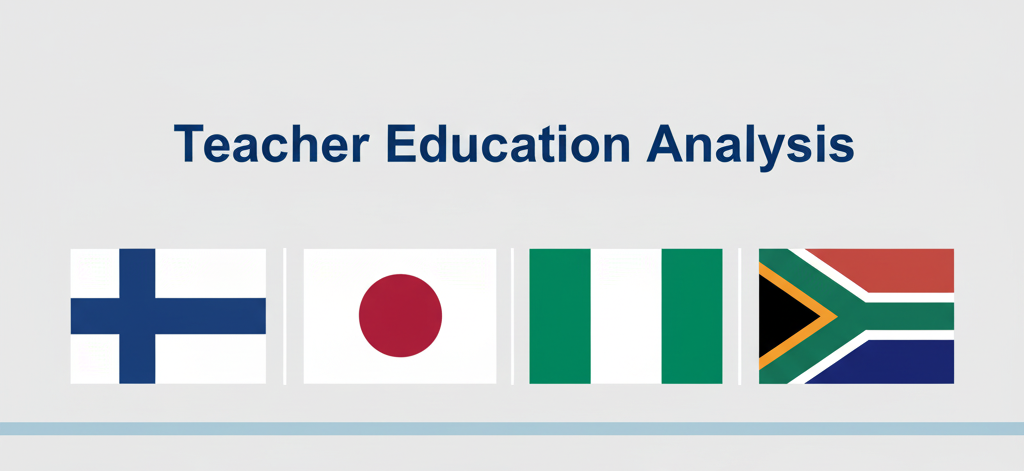
This study is divided into three sections. First, it examines best practices in teacher education in the Finnish, Japanese, and South African contexts, inquiring into pre-service and in-service teachers’ education policies, selection processes for teachers’ education, class teacher education requirements as applicable to basic education, Continuing Professional Development (CPD), and quality assurance. The second section explores the state of teachers’ salaries, professional autonomy, and freedom of association that defines their status in the mentioned countries. The third section provides an overview of Nigeria’s teacher education and challenges, and concludes with recommendations for government policy reform and teacher-led interventions.
Finland
Teacher education policy and reforms. The Finnish Ministry of Education and Culture is deeply involved in teachers’ and students’ education. However, this does not imply a rigid top-bottom approach but one that is collaboratively developed and decentralized. The Ministry, alongside tenured scholars, provides policy frameworks for selection requirements, pre-service teacher education, and qualifications requirements for job entry. To resolve equality concerns nationally, the Ministry ensured that universities in every region have a teacher education institute. The government primarily funds teacher education. However, all universities are required to abide by government policies of market demands that stipulate the yearly enrollment quota for teaching programs. The rationale of this policy is to produce the right amount of educators the education job market needs and avoid teachers’ unemployment (Mankki & Pekka Räihä, 2023).
Furthermore, quality in the Finnish education system is defined by the rigorous process of candidate enrollment, the extensive structure and content of preparatory education, and the qualifications required to enter the profession. The system maintains a tradition of having only qualified teachers in schools. For example, 96 and 97 percent of pre-primary and basic education teachers were reported as fully qualified (Eurydice, 2023).
Candidate selection process. “Classroom teaching is considered an independent and creative, high-status profession that attracts some of the best secondary school graduates each year” (OECD, 2014, p. 174). Since 2017, candidate selection processes have included a two-phase screening system. The MoE facilitates the first phase. Candidates desiring to get into class-teacher education must pass a literacy test called VAKAVA (the National Educational Selection Cooperation Project), consisting of 180 pages of articles to test candidates’ memorization, comprehension, and knowledge application abilities. Only successful candidates can move to the second phase, which universities administer. This second phase consists of an interview and a group discussion task that aims to evaluate candidates’ motivation, aptness, and commitment to the program. To sum up, getting into teacher preparatory education is highly competitive in Finland, and not all candidates get into the program. The selection process is so rigorous that only “1 in 4 applicants to teacher training is accepted, including only 1 in 10 for primary school teacher preparation” (Darling-Hammond, 2017, p. 298).
Class teacher education. Class teachers are expected to complete a five-year Bachelor’s and Master’s degree to qualify for the teaching profession. All teachers must major in educational science for 150 Credits and a 40 Credits Master’s thesis, which includes pedagogical studies, didactics, supervised practice teaching, and a multidisciplinary study of school subjects for the primary level concentration of grades 1 to 6 and 7 to 9. Furthermore, learning and teaching research is an essential component of teacher education legislated through Act 794/2004, which aims to improve teachers’ competencies in the application of scientific data to instructional practices and to develop autonomous practitioners who can self-reflect on their instructional practices, justify their pedagogical decisions and are capable of participating in school curriculum development. In addition, special education specialists are required to undergo further education. Class teachers’ education also prepares them for evaluating whether students need special education assistance – a program funded by the Ministry of Education.
Continuing Professional Development (CPD). As mentioned above, the Finnish Ministry of Education actively participates in funding and setting frameworks in all aspects of the country’s teacher education system. They also make provisions for in-service continuing education for teachers. The Finnish National Agency for Education (EDUFI), the Regional State Administrative Agencies, and the Ministry of Education fund universities and teacher institutes for teachers continuing education. In addition, as part of a professional development scheme, a national teachers’ education forum is held where educators discuss issues and develop themes useful for improving pre-service and in-service education.
As part of the Continuing Professional Development (CPD) activities, the forum is also used for monitoring trends and performances (Eurydice, 2023). Although the state provides funds and grants, both teachers and employers are responsible for applying and participating in professional development training because there is no policy governing CPD for teachers at the basic education level; however, teachers are obliged to attend 1 to 5-day CPD every year, and employers bear the primary responsibility of assigning CPD to full-time teachers.
Quality assurance. Education providers such as schools are obliged to evaluate the quality of education they provide according to set guidelines set by the law. These institutions are also expected to participate in external evaluations executed by the Finnish Education Evaluation Centre (FINEEC) and are supported in developing internal quality assurance activities. There are no school inspections or a national system for teacher evaluation; however, a national review of learning outcomes, themes, and systems is regularly evaluated through collaborated teachers’ work (Eurydice, 2023).
Japan
Teacher education policy and reforms. Educators in Japan are all under government jurisdiction and are therefore considered government workers. The Ministry of Education, Culture, Sports, Science, and Technology (MEXT) is the body responsible for regulating national educational policies and reforms. MEXT developed teacher certification in 1949 with a procedure that grants Class 1 or Class 2 teaching certificates or administrative licenses to candidates who have attended university or colleges and have completed the coursework required by the law, “regardless of his or her university or field of study” (Yamasaki, 2016, p. 20). The “open system” practice is intended to speed up teachers’ recruitment after the war.
However, teachers’ education policy changed between 1953 and 1999 as a movement to improve the quality of teachers. So that, instead of the previous “open system” that issued licenses to candidates from any college and university, teacher candidates are now required to earn their teaching degree from specific accredited institutions under the MEXT and the MoE. It also requires credits in specific educational programs and professional and academic courses. Policy reforms from 2015 indicated three types of teaching licenses: Advanced certification for Master’s degree holders, Class 1 for Bachelor’s degree holders, and Class 2 for associate degree holders (attained from junior colleges). These are licensed to teachers who have completed the legally required credits from approved education programs and institutions (Yamasaki, 2016).
Candidate selection process. Unlike the meticulous Finnish system that screens candidates before getting into the preparatory teachers’ program, the Japanese selection system screens at the teaching profession’s entry stage as indicative of the “open system” discussed above. In the fourth year of preparatory teacher’s education, student-teachers are required to undergo a two-phase employment test by the Board of Education. The first phase is a written test that examines knowledge of pedagogy, education laws, aptitude, etc. Student-teachers successful in the first stage undergo a second examination that includes an interview, practical teaching, and a written test. Successful candidates are notified and then posted to schools. In addition, students who have completed the legal coursework required can submit certification applications and academic transcripts to the Board of Education (Yamasaki, 2016, p. 26).
Class teacher education. Class teachers’ education requirements range from associate degrees to Master’s degrees. A Class 1 certificate is the minimum requirement for teaching elementary and lower junior levels in Japan. Bachelor’s degree education for teachers includes the significance of teaching, the basic theory of education, curriculum and teaching methods, methods to students guiding and counseling, practical teaching, and seminars. Both primary and junior high school teachers are required to study all class subjects. Student-teachers must pass the legally required 41 credits with eight credits of all the required class subjects, while those of lower high school must study 20 credits in class subjects (Yamasaki, 2016).
Continuing Professional Development (CPD). The Japanese MoE has a compulsory policy for continuing teacher education at all levels of the teaching profession. First, experienced teachers at posted schools provide newly assigned teachers guidance and mentorship. Second, the Board of Education offers compulsory development training at special staff development centers. Third, the Board of Education also has standard teacher training to support experienced teachers’ career aspirations as curriculum coordinators, directors, department supervisors, vice principals, and principals.
Furthermore, “Konai Kenshu” (school-wide professional development) is a form of in-service education for teachers that uses research to advance teachers’ knowledge and practice. Teaching staff at individual schools collectively develop and conduct research studies to improve instructional practices and overall education quality. Reports are then published and presented at educational seminars. Similarly, primary and lower high school teachers share one staff room, trade information, and coordinate planning together. These practices are considered an essential part of professional development measures for Japanese teachers. It is a common practice for Japanese teachers to participate in seminars offered by educational institutions and teacher education providers (Yamasaki, 2016).
Quality assurance. Different schemes have been developed to promote the professional development of teachers and quality thus far. The schemes commonly used are the “Efficiency Rating Plans” for measuring new teachers’ performance; the academic goals implementation assessments; lesson observations; and self-evaluation of performance and competence. This is undertaken by school principals, vice principals, and superintendents (Katsuno, 2010). In addition, teachers are expected to renew their licenses every ten years – a framework known as the Teachers License Renewal Scheme (TLRS) whereby teachers take “30 hours of lectures.” on teaching contents and pedagogies. This scheme has also been reported to be a mechanism for eliminating incompetent teachers (Saito & Murase, 2011).
South Africa
Teacher education policy and reforms. The prior policies governing teacher education in South Africa mirror the apartheid system and its cultural norms. Teacher education for Blacks, Colored, Indians, and Whites varies differently. For emphasis, except for White educators, others received little to no funding, negatively impacting education quality in segregated schools. Wanjohi (2011) reported that “Black schools had inferior facilities, were often without textbooks, and had teachers with no, or poor professional qualifications” (Wanjohi, 2011, p. 1). However, at the break of a significant political reformation in 1994, led by Nelson Mandela and colleagues, a democratic government was reinstated, which came with a united national vision for the education system, including teachers’ education. From this moment, the indispensable role of teachers as instigators and propellers of the intellectual, moral, cultural, and democratic life of the country’s young generation was emphasized.
The primary problems reported by the Ministerial Committee on Rural Education (2005) revealed that first, teachers lacked conceptual and content knowledge of the subjects they were teaching. Second, the shortage of qualified and competent teachers, especially in Mathematics, Science, Technology, Languages, Arts, Economics, and Management Sciences, in Foundation and Intermediate Phases, needs to be solved (South African Government, 2006).
Policy actions that followed include a collaborative national electronic database with data inputs from regional education departments and other educational institutions to keep track of teaching recruitment gaps at all levels and their sources; a provision of the service contract by MoE to fund programs for recruiting candidates into preparatory teachers education; a standard professional qualification; induction and mentoring programs for new teachers; provision of monetary incentives to recruit and maintain educators with exceptional performance, and those from poor neighborhoods. Finally, the reforms provided in-service professional development to enhance teachers’ subject knowledge and skills.
Candidate selection process. Due to the shortage of teaching professionals, the Ministry operates an “open system policy” that allows interested candidates to enroll in the education degree program at any university nationwide. During South Africa’s Apartheid, “96% of teachers in White schools had professional teaching qualifications, whereas only 15% of teachers in Black schools were qualified” (Wanjohi, 2011, p. 5). This policy sought to mend apartheid racial discrimination policies that had denied non-white teacher populations access to formal teacher training. It also provides access to a year Post Graduate Certificate in Education (PGCE) to candidates who have completed a Bachelor’s degree in other fields but want to transition to teaching.
Class teacher education. There is no account of special preparatory Education or requirement for class teachers. Basic Education in the South African education system includes primary, lower secondary, and secondary stages different from the Finnish and Japanese systems. Teachers in South African Basic Education all share a common Initial Professional Education of Teachers (IPET) requirement of a four-year Bachelor’s degree in Education that includes a year of practical teaching service. The MoE argues that the academic and pedagogical preparative structure and content requirements were sufficient for preparing teachers to teach the basic education curriculum. The one-year practical teaching service allows student-teachers to settle into a specialization that ranges from the Foundation stages; Intermediate stages; Senior stages; and Senior high stages according to the Higher Education Act of 1997.
In addition, the policy also provided a post-graduate degree for candidates with other degrees outside Education but who wish to teach. The one-year post-graduate program provides them with practical training and specialization. Finally, an alternative route is provided. A hybrid three to four-year diploma in distance learning modes is provided to teachers with no preparatory education or qualification. The flexibility of this diploma makes practical accommodations for disparities in teacher education access and for those in rural areas (South African Government, 2006).
Continuing Professional Development (CPD). Before 1994, both pre-service and teacher-in-service education were nonexistent. The 2003 TIMMS Study exposed the ineffectiveness of the previous CPD training under the first policy reform that did not transmit to the classroom. The 2005 curriculum set the tone for a national education that requires new instructional and assessment methods. Several initiatives and programs were introduced to facilitate teachers’ professional growth and development. They include mentorship programs, workshops, and conferences (Department of Basic Education, 2019).
In addition, the South African Council for Educators (SACE) also developed new policies for CPTD to integrate knowledge in specific disciplines with pedagogic proficiencies and align training programs with classroom practice. The system works directly for “the improvement of the quality of teaching; reinforcement of the professional status of teaching; guidance about which Professional Development (PD) activities will contribute to their professional growth” (South African Government, 2006, p. 17).
More distinctively, the new CPTD promoted indigenous language at the teachers’ PD training level. It emphasized that teachers should be allowed to learn and achieve proficiency in their Indigenous African Language, which will help “link between language and learning.” In addition, teachers are given the freedom to choose some courses to encourage autonomy in championing their own development. However, the policy also deemed some courses mandatory. They are categorized as “School-driven; Employer-driven; Qualification-driven; and others from external educational service providers” (South African Government, 2006, p. 18).
Quality assurance. As a requisite for practice, all teaching professionals are required to undergo registration with the South African Council for Educators (SACE). In addition, the national education plan makes provision for evaluating teachers’ improved efficiency through the recognition of Professional Development programs. The CPTD is a new system developed to help maintain teachers’ standards through continuing in-service training of points. Teachers must achieve set points in PD courses evaluated every three years. Failure to undergo further PD is punishable by SACE cancellation of teaching licenses that could be re-applied for after teachers have fulfilled specific teaching standards.
Teachers’ Status
Various factors affect the status of teachers, including but not limited to salaries, working conditions, level of professional autonomy, and freedom of association. These factors can have significant impacts both professionally and personally for teachers. For example, teachers should have the right to collaboratively conduct research to advance knowledge in their field (Symeonidis, 2015, pp. 17-18). However, losing professional autonomy, as is commonly experienced by teachers in many parts of the world, confers a lack of regard for educators’ valuable knowledge and professionalism and also deprives them of the ability to be effective teachers for students (Darrell de Klerk, 2014).
Teachers’ professional autonomy has always meant teachers are responsible for curriculum design, class instruction, and assessment; however, as I have argued in my introduction, the neoliberal movement has stripped away teachers’ independence and imposed curriculums and measures that undermine teacher competencies—still, the successful implementation of curriculum centers around teachers. Teachers’ sense of ownership and self-directness will determine whether teachers will adopt or ignore the curriculum (Kennedy, 2010). Based on factors such as the selection process, requirement qualifications, compensation package, professional autonomy, and freedom of expression and association, this section will examine the different levels of teachers’ statuses in Finland, Japan, and South Africa.
Finland
The teaching profession is regarded highly in Finland. Several factors can be attributed to this fact. Firstly, teacher education selection is highly selective, accepting only 15 percent of applicants a year who are carefully selected (Darling-Hammond, 2017, p. 298). Secondly, preparatory teacher education for Basic Education not only trains teachers in theory and practice but also equips them to become researchers and innovators. Teachers’ salaries vary based on their experience level, ranging from novice to veteran. According to a report from 2006, the salary range for new teachers in lower secondary education is between $30 793 and $30 963, while upper secondary teachers receive a similar range. Teachers with fifteen years of experience can expect to earn $38 269 and $42 440 for upper secondary teaching positions (Akiba et al., 2012, p. 177). A 2023 OECD report shows the annual salary range for pre-primary and primary level teachers between $32 525 and $48 518, depending on years of experience. Similarly, experienced teachers in lower and higher secondary salaries begin at $39 824 to $56 245, depending on years on the job. (OECD, 2023).
What is teachers’ perception of their autonomy? In the area of curriculum, although Finland has national curriculum frameworks in place for upper secondary schools, the setting of objectives, type of instruction, and modification of content for relevance are the responsibility of teachers. Schools and teachers are required to customize the implementation of curriculum to fit their school’s unique context. Furthermore, teachers within the vicinity of a given region engage in joint efforts with the education board to ascertain essential aspects of the curriculum (Erss et al., 2016). Finnish teachers are reported to enjoy a considerable degree of autonomy within their profession, regardless of a national curriculum framework. Results from the work of Erss et al. (2016)demonstrate that “as long as the exam results are good, [Finnish teachers are convinced that they] may choose whatever pedagogical approach they wish.” Moreover, Finnish curriculum topics are comprehensive for some subjects, so teachers can influence the content and methods (Erss et al., 2016, p. 596).
Teachers’ unionizing is a standard practice in Finland. The OAJ is an institutional union of education in Finland. It is an umbrella body for all working educators in the classroom or the research sector. The OAJ provides advocacy, negotiation, and security for teachers. Its goal is to “exert influence wherever decisions on the well-being of its members are made: at work, in education, and in society” (OAJ, n.d.). In addition, the Finnish teachers’ union owns and operates the Opettaja and Opeopiskelija magazines. To conclude, the level of independence and respect teachers have in their profession is directly linked to the investment in their education and the trust placed in the quality of their assignments.
Japan
The Japanese teaching profession has its roots in cultural and spiritual principles. “Confucianism is a philosophical system based on the teachings of the Chinese philosopher Confucius. [The] teachings involve the values of righteousness, honesty, wisdom, harmony, loyalty, and respect (Levent & Karsantık, 2018, p. 9). It emphasizes humanism and sees self-development as the path to achieving a cultivated personal and collective life. Teachers’ ongoing professional development, as widely accepted in Japan, is a byproduct of this philosophy. Teachers are also perceived and expected to demonstrate competency, diligence, and perseverance. Notwithstanding, according to an international report, the Japan Teacher Union (JTU) reported that teachers are “accorded a high or very high status in society.” However, despite the fact that teachers have similar job entry requirements as doctors, teaching occupation status seems to be lower in comparison, as a result of “salary cuts or wage freezes, poor working conditions, negative media image, the introduction of market-based reforms and privatization policies” (Symeonidis, 2015, pp. 28-33).
The political influence to impose privatization on Japan’s education system has reduced government resources devoted to teachers’ Continuing Professional Development and weakened the sovereignty of the Japan Teacher Union (Saito & Murase, 2011). Furthermore, targeted educational reforms such as “testing-based accountability” have negatively impacted teachers’ sense of identity and professionalism. This system allows students’ academic performance as the primary criterion to evaluate teachers’ competence. This competitive practice among schools was reported to encourage educational practices undermining teachers’ professional autonomy and self-efficacy (Katsuno, 2012; Saito & Murase, 2011). As of 2006, the starting pay for Lower and Upper Secondary teaching positions was $26 256. Lower and upper secondary teachers with 15 years of experience receive a salary of $49 097. According to the 2023 OECD report, primary school teachers can earn a starting salary of $29,820 and potentially increase it to 61,067. Similarly, the compensation range for educators in middle and high schools varies from $29,820 to $62,670, depending on their length of service (OECD, 2023).
South Africa
The 2018 Teaching and Learning Internal Study (TALIS) under the OECD report that 61 percent of South African teachers believe their profession is valued by society (OECD, 2018). The political situation in South Africa significantly impacted teacher status. According to the teacher education analysis, the quality of teachers during the transition to democratic government was poor. The high demand for teachers after Apartheid influenced recruitment trends. As a result, the government skipped the selection criteria process and instead provided an open system where anyone could be enrolled in teaching programs. SACE reported that among “6000 new teachers likely to graduate in 2006, fewer than 500 will be competent to teach in African languages in the Foundation Phase” (South African Government, 2006, p. 12).
Teachers’ salaries vary by grade level, the importance of the subject, teachers’ qualifications, points earned through PD programs, and years of experience. For example, an article reported that the average salary for teachers is R258 060 per year. Newly qualified teachers earn around R182 500, while the average high-school teacher earns R298 815 per year(Melzer, 2022). Aidan Horn (2020) discussed some key aspects of teacher remuneration history in South Africa. The “differential pay for different skill levels” policy in 2007 was introduced to attract and retain skilled teachers through a “progressive salary structure.”
However, Horn 2020 argues that the framework for earning more works against long-serving teachers compared to their equals in a different profession. Each year, salaries only increase by one percent. However, between 2018 and 2019, the Centre for Education Policy Development (CEPD) agreed to increase teachers’ annual wage by one point five percent- a policy that has helped to advance teachers’ salaries to the rank of other professions (Horn, 2020, p. 13). Teacher professional autonomy, as defined in the introductory paragraph, is a matter of great political controversy in Post-Apartheid education institutions. Given the historical account of Apartheid State control over teachers, curriculum, and assessment, teachers’ subjugation, little to no teacher education opportunities for Africans, Colored, and Asians teachers, the Post-Apartheid education policies that aimed at fixing both teachers and students’ education gap faced skepticism and pushback by the country’s Democratic Teachers Union. Jansen 2004 argues that even “when appraisal involves teachers, and works in their own interests, deeply held convictions and suspicion of outsiders continue to work against teacher regulation and professional development in the form of external appraisals” (Jansen, 2004, p. 2).
In order to address the deterioration in education and build up the teaching force, the government developed certain policy documents such as the COTEP (Committee on Teacher Education Policy) Norms and Standards for Teacher Education, which outlines specific roles and conducts expected of teachers, roles, and standards for employers to evaluate teachers. Furthermore, the SACE’s Code of Conduct document specifies rules for teachers’ and employees’ code of conduct on the issue of human rights and disciplinary actions if obstructed. In addition, the Education Labor Relations Council (ELRC) Manual for Developmental Appraisal and the National Department of Education Duties and Responsibilities of Educators (Barasa & Mattson, 1998, p. 47). However, to what extent are teachers allowed professional autonomy, freedom of expression, and unionization? Evidence suggests that the central and provincial governments brought in reforms to transform South Africa’s education system. In addition, according to Jasen’s 2004 report, the Ministry of Education “led a series of attacks on teachers and the South African Democratic Teachers Union (SADTU). This action is believed to explain the fragmented relationship between the Ministry of Education and the South Africa Teachers’ Union to this day.
The government further set many top-down initiatives, such as “a cascade model of teacher training to assist teachers in the implementation of Curriculum 2005 to change the content of apartheid education”. In addition, it sponsored a National Professional Diploma in Education (NPDE) to upgrade “the qualifications of more than 25% of under-qualified teachers in the nine provinces of South Africa.” It launched a compulsory registration of all teachers and the setting of entry qualification into the profession, in addition to a professional Code of Conduct was established to regulate educators’ professionalism.
Although these evaluation policies were focused on improving teaching quality and professional conduct, they were perceived by the Teachers Union as an infringement on teachers’ autonomy (Jasen, 2004, pp. 4-8). The South African Democratic Teachers Union (SADTU) is actively involved in safeguarding teachers’ rights and will protest against policies that threaten educators’ autonomy. However, based on evidence, the union appears weak and less influential. It is important to keep in mind the political history and unique context of South Africa’s recovery that allows for a State-intervention and centralized control of curriculum, teacher education, and professionalism. Clearly, teachers’ professional autonomy and status are lacking, as evidence supports.
Nigeria Teacher Education Review
This section will provide an overview of teacher education in Nigeria. The Nigeria Ministry of Education runs an open system that allows all accredited Universities, Polytechnics, and Colleges of Education to provide teacher preparatory education throughout the country. Bearing some similarities to South Africa, Nigeria was colonized until 1960. The National Commission for Colleges of Education and Teacher Education in Nigeria (NCCE) was established to ensure the standardization of a national teacher education curriculum and to conduct “a periodic review of courses taught” in higher institutions nationwide. The NCCE was also responsible for supervising and improving the quality of preparatory teacher education.
The Preparatory teacher education structure includes a three years National Certificate in Education (NCE) and a year of paid internship, after which a full teaching certificate is awarded (Federal Republic of Nigeria, 2012). The NCE is the minimum entry qualification into the teaching profession. In addition, the program includes “general studies; the sociology and philosophy of education; language and communication; teaching methodologies; subjects of concentration; technology; and teaching practice.” Student-teachers are expected to have completed 130 units before graduation (Jibril, 2008). There is no special selection process for entering the teaching program. However, the selection criteria for the NCE program are as follows: “A Senior Secondary School Certificate (SSC), NECO, or GCE ‘O’ Level with four credits at a maximum of two sittings including English Language and Mathematics.” In addition, prospective candidates must also pass the Joint Admissions and Matriculation Board (JAMB) examination with a minimum score of 140 (Ogundimu, 2022).
With regards to Continuing Professional Development (CPD), according to the MoE 2014 policy on teacher continuing education under Principle 7, “teachers shall be required to participate in at least one CPD program of at least 4-day duration once every two years in order to maintain his/her professional status,” based on needs assessed by the school management committee of each school. The policy also makes grant provisions for teachers’ CPD, which the school head will help process (Nigeria Federal Ministry of Education, 2014). All around the world, social, economic, and technological changes are changing the world. This calls for the professional and personal development of Nigerian educators. Several issues are identified within teacher education in Nigeria. These are issues relating to the Nigerian government’s attitude toward education and teachers’ education; shortage of adequate teacher educators; narrow specialization; inadequate infrastructure; inadequate preparatory and CPD teacher programs; weak accountability system; and continuous union strikes.
For example, despite the high increase in enrollment, budget allocation to teachers’ education programs remains low, and student-teachers are limited to the range of subjects’ specialization to choose from when selecting their area of expertise in their field of study, hence the insufficient number of teacher-educators in Early Years and Special Education specializations. In addition, even though a Ph.D. qualification is the minimum requirement for teacher-educators, only 43 percent are qualified, which has dire ramifications on teacher education and graduates’ education quality and preparedness. At most, 60 percent are qualified in seven Nigerian universities. Furthermore, the Teacher Education Regulatory Board (TERB) and the National Commission for Colleges of Education (NCCE) have also contributed to the accountability problem that ought to supervise higher education quality. Likewise, the constant union strike has negatively impacted the education programs’ credibility and the quality of graduates produced. (ASr & Jacob, 2020).
Conclusions and Recommendations for Nigeria’s Teacher Education Reform
There is a noticeable difference in the education policy response between countries that have suffered some form of cultural and political disruption from countries that have enjoyed decades of political stability. Finland is an example of the latter, and has enjoyed uninterrupted development built from decades of peace and investment in human capital. These factors have translated into a decentralized educational framework where teachers and educational scholars work collaboratively on provincial and national educational policies and have contributed to the framework and practices of teachers’ and students’ education. In addition, the investment in teachers’ education, over time, has produced capable and innovative educators who can be trusted to uphold these pillars. Numerous lessons can be learned from Finland, Japan, and South Africa’s teacher education structures and practices. This section will reflect on Finland, Japan, and South Africa’s teacher education policy and practices and their applicability to Nigeria’s teacher education system.
Firstly, the Finnish government prioritizes and funds teachers’ education. One of the points under Nigeria’s education review is the low allocation of funds to teacher education. Prioritization of education quality in Nigeria will bring more funds to teacher education. Secondly, the Finnish MoE maintains a tradition of only having qualified school teachers. This goal is not unattainable for Nigeria’s education. Nigeria’s Ministry of Education could learn from South Africa’s alternative teacher education policy for pre-service and in-service PD, which focuses on removing barriers for teachers to attain education. Nigeria’s MoE could also apply South Africa’s CPDT system of maintaining teachers’ standards through continuing in-service training of points. The system requires teachers to take some compulsory courses and others initiated by them. In addition, teachers are required to earn specific CPD points, which are evaluated every three years.
Thirdly, the meticulous selection process of candidates for teacher education is why Finnish schools have committed and visionary teachers who become educational innovators. As mentioned in my analysis, in consolidation with the government, only 15 percent of applicants are accepted into teacher education programs in Finland. Candidates’ knowledge, career intentions, skills, and ability to work collaboratively are screened carefully. The current admission requirement for Nigeria’s teacher education program is inferior to other fields. There is a need for Nigeria MoE and NCCE to reform teacher education admission requirements. Fourthly, to solve the current shortage in teacher education specialization in the Early Years and Special Needs Education, Sustainable Development Goal 4(7)c encourages “increasing the supply of qualified teachers [and teacher-educators] through international cooperation for teacher training in developing countries…” (United Nations, 2015, p. 25). For emphasis, overcoming the problem of insufficient specialized teachers in Nigeria K12 will require not only providing qualified teacher-educators and quality education but also incentivizing the positions to attract young prospective teachers.
Furthermore, Little (1993) argued against the conventional approach to CPD after conducting a study on the effectiveness of conventional CPD on teachers’ educational needs. How much do teachers retain from seminars, conferences, and a few days of workshops? His study reported that these methods saw less participation and were less effective in transitioning new knowledge to classroom practices. It is a fact that the banking system of education does not lead to learning or transferability of skills in both student and teacher education. Hence, there is a need to reconceptualize the approach to teachers’ PD to one that allows the “active initiation and participation” of teachers, a change from “working on teachers to working with teachers,” to encourage teacher agency, to support teachers’ innovative ideas and encourage peer community of learners (Iyunade, 2017, p. 74). It is equally important to emphasize that the lack of autonomy hinders growth in teachers and deprives students and the education community of reaching effective solutions for today’s education and social challenges.
Additionally, the Nigeria MoE should work alongside Nigeria Teacher Unions to improve the status of teachers through improving “working conditions and salaries, career progression and opportunities to work in other areas of education, academic freedom, autonomy, and involvement in decision-making, and positive media image” (Symeonidis, 2015, p. 69). Finally, alternative and most effective forms of Continuing Professional Development are the kinds where teachers work collaboratively with other teachers to solve the complexities of their education and students’ learning. For example, in Japan, teachers share knowledge and plan together. In addition, experienced teachers serve as mentors and coaches to new teachers. Finnish teachers collaboratively conduct research studies. These are some practices Nigeria teachers could emulate. In conclusion, teachers are agents of change in our society. This study has looked at different practices and policy reforms in Finland, Japan, and South Africa and has found irrefutable evidence of the critical need for Nigeria’s teacher education improvement. More evidence within and outside this study agrees that professional autonomy, trust, and local and national support must be restored to enhance teachers’ capabilities and sense of professional duty.
References
Akiba, M., Chiu, Y., Shimizu, K., & Liang, G. (2012). Teacher Salary and National Achievement: A Cross-National Analysis of 30 Countries. International Journal of Educational Research, 53, 171-181.
ASr, M. U., & Jacob, O. N. (2020). Teacher education in Nigeria: Problem, issues, and suggestions. International Journal on Integrated Education. 3(11), 108-113. https://doi.org/10.31149/ijie.v3i11.843
Barasa, F. S. & Mattson, E. (1998). The roles, regulation and professional development of educators in South Africa: a critical analysis of four policy documents, Journal of Education, 23, 41–72.
Department of Basic Education. (2019). Professional Development for Teachers. Retrieved from https://www.education.gov.za/Programmes/Teacherdevelopment/ProfessionalDevelopmentforTeachers/tabid/449/Default.aspx
Darling-Hammond, L. (2017). Teacher education around the world: What can we learn from international practice? European Journal of Teacher Education, 40(3), 291–309.
Darling-Hammond, L. (2000). How Teacher Education Matters. Journal of Teacher Education, 51, 166–173.
Eurydice. (2023, March). Teachers and education staff – Finland. Eurydice. Retrieved from https://eurydice.eacea.ec.europa.eu/national-education-systems/finland/teachers-and-education-staff
Eurydice. (2023, April). Continuing Professional Development for Teachers Working in Early Childhood and School Education. European Commission – Wiktionary. Retrieved from https://eurydice.eacea.ec.europa.eu/national-education-systems/finland/continuing-professional-development-teachers-working-early
Erss, M., Kalmus, V., & Autio, T.H. (2016). ‘Walking a fine line’: Teachers’ perception of curricular autonomy in Estonia, Finland, and Germany. Journal of Curriculum Studies, 48, 589 – 609.
Federal Republic of Nigeria. (2012.). Nigeria Certificate in Education Minimum Standards for General Education. NCCE. Retrieved from http://www.ncceonline.edu.ng/NCCE-Digitization/minstandard/new_cul_pdf/general_edu .pdf
Horn, A., Donaldson, A., & Leibbrandt, C.M. (2020). Teacher Remuneration in South Africa: Incentivizing Performance Economics Masters Minor Dissertation.
Iyunade, O. (2011). Teachers’ Continuing Professional Development as Correlates of Sustainable Universal Basic Education in Bayelsa State, Nigeria. African Research Review.
Jansen, J.D. (2004). Autonomy and accountability in the regulation of the teaching profession: a South African case study. Research Papers in Education, pp. 19, 51–66.
Jibril, M. (2008). Teacher Education in Nigeria: An Overview. African Research Review, pp. 1, 116–124.
Katsuno, M. (2010). Teacher evaluation in Japanese schools: An examination from a micro-political or relational viewpoint. Journal of Education Policy, 25(3), 293–307.
Katsuno, M. (2012). Teachers’ Professional Identities in an Era of Testing Accountability in Japan: The Case of Teachers in Low-Performing Schools. Education Research International, 2012, pp. 1–8.
Klerk, D., & Darrell, E. (2014). Teacher autonomy and professionalism: a policy archaeology perspective.
Kennedy, K. J. (2010). School-based curriculum development for new times: A comparative analysis In E. H.-F. law & N. Nieveen (Eds.), Schools as curriculum agencies. Asian and European perspectives on school-based curriculum development pp. 3–20.
Levent, F., & Karsantık, İ. (2018). Teacher Training Policies in Japan in the Context of Ethical Values. Turkish Journal of Business Ethics.
Little, J. W. (1993). Teachers’ Professional Development in a Climate of Educational Reform. Educational Evaluation and Policy Analysis, 15, 129-151. https://doi.org/10.3102/01623737015002129
Nigeria Federal Ministry of Education. (2014). National Teacher Education Policy. Planipolis. Retrieved May 17, 2023, from https://planipolis.iiep.unesco.org/sites/default/files/ressources/nigeria_teacher_policy.pdf
Ogundimu, A. (2022). JAMB Cut off Marks 2022/2023 for Universities, Poly, Colleges. NGScholars. Retrieved May 17, 2023, from https://www.ngscholars.net/jamb-cut-off-marks/
OAJ. (n.d.). The Trade Union of Education in Finland. OAJ. Retrieved May 17, 2023, from https://www.oaj.fi/en/
OECD (2014). PISA 2012 results in focus: What 15-year-olds know and what they can do with what they know, 1-44.
OECD. (2014). Lessons from PISA for Korea, strong performers and successful reformers in education. OECD Publishing.https://doi.org/10.1787/9789264190672-en.
OECD. (2018). Education GPS – South Africa – Teachers and teaching conditions (TALIS 2018). Education GPS. Retrieved from https://gpseducation.oecd.org/CountryProfileplotter=h5&primaryCountry=ZAF&treshold =5&topic=TA
OECD (2023), Teachers’ salaries (indicator). Doi: 10.1787/f689fb91-en https://stats.oecd.org/viewhtml.aspxdatasetcode=EAG_TS_STA&lang=en.
Saito, E., & Murase, M. (2011). Adversity in teacher education in Japan: Professional development or professional impoverishment?
South African Government. (n.d.). National Policy Framework for Teacher Education and Development. South African Government. Retrieved from https://www.gov.za/documents/national-policy-framework-teacher-education-and-develo pment
Staff. (n.d.). The Status of Teachers and the Teaching Profession. https://www.ei-ie.org
Symeonidis, P. (2015). The Status of Teachers and the Teaching Profession: A Study of Education Unions’ Perspective. Education International Research Institute.https://www.ei-ie.org
UN (2015). Transforming Our World: The 2030 Agenda for Sustainable Development. Resolution Adopted by the General Assembly on 25 September 2015, 42809, 1-13. https://doi.org/10.1007/s13398-014-0173-7.2
UNESCO. (2013). UNESCO handbook on education policy analysis and programming, volume 1: education policy analysis. UNESCO Publishing. https://unesdoc.unesco.org/ark:/48223/pf0000221189
Ville Mankki & Pekka Räihä. (2023). The hidden admission agendas in Finnish primary teacher education in the 1990s, 2000s and 2010s, History of Education, 52:1, 76-89, DOI: 10.1080/0046760X.2022.2080283
Wanjohi, A.M. (2011). Education Reforms in South Africa and Tanzania: Lessons for Kenya. KENPRO Online publications. http://www.kenpro.org/papers/education-reforms-south-africa-tanzania-lessons-kenya.htm
Yamasaki, H. (2016). Teachers and Teacher Education in Japan. Bull. Grad. School Educ. Hiroshima Univ., Part III, No. 65, 206, 9-28